Archive for the 'mexico' Category

Getting to Guatemala

Monday 16 October 2006 @ 16:42

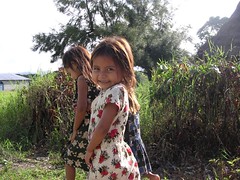
Guatemalan traditional dress Petèn Flores Coban Guatemala Central America

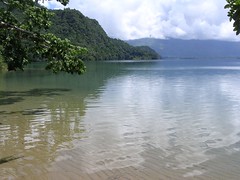
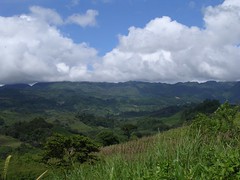
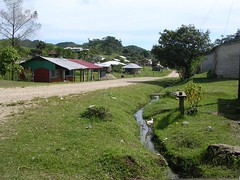
The song of the jungle awakes us very early and while we have breakfast we are wrapped by a misty fog. In our mind slide fast the memories of three months spent in Mexico, looks and smiles of the people known or just grazed… crossing the frontier between Mexico and Guatemala do not involve the tragic intensity of travelling from the United States to Mexico: simply we move on the other side of the river Usumacinta, from Frontera Corozal to Bethel. Here we find again the same jungle, the same bajareques (houses of wood and adobe, a mix of mud and straw), the same pleasant smiles. The unpaved, muddy road drives us along green grasses and hills, until the lake of Petèn Itzà. We start to notice the first differences with Mexico, the first days in an unknown country are always the most difficult, but also the most stimulating. Walking between the island of Flores and the pueblo of Santa Elena, we breathe an Asian atmosphere, even if it’s an image that lasts for a second: a lot of powder and hundreds of “risciò” and small vehicles adapted to the transport of passengers.

  • Share/Bookmark

Frontera Corozal, Lacandon jungle

Sunday 15 October 2006 @ 23:04

Rio Usumacinta Mexico Guatemala border Central America Lacandon jungle Chiapas adventure

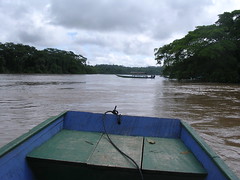
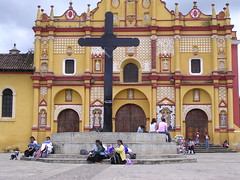
The last Mexican night flies away slowly but inexorably, like the course of the rio Usumacinta, where we are staying now. The road that has lead us from the highlands near Comitàn to Frontera Corozal, it is a hard way through an incredible landscape. After the wonderful Lagunas de Montebello, some blue and green emerald lakes encircled by pines, the road falls down towards the jungle, along the border with Guatemala. That’s why it is called “carretera fronteriza”. Until the village of Benemerito de Las Americas, we observe the fruit of decades of totally irrational exploitation of the territory. With the promise of an easy land, the campesinos from the highlands were sent here (see the experience of ejido Emiliano Zapata), every time deeper in the heart of the Lacandon jungle. But the absence of a clever agricultural project forced to an extensive and unproductive exploitation of the land. As dramatic consequence, we see a forest in agony and the return of the large estate owners, in places where they could never have arrived even with enormous resources. Frontera Corozal isn’t free from these problems, but its inhabitants seem to have found a valid alternative in projects of “ecotourism”, thanks to the beauty of the river Usumacinta and the wealth of life along its sides (finally we have seen the howler monkeys!). Moreover a few kilometers from the community there are Mayan ruins such as Yaxchilan and Bonampak.
  • Share/Bookmark

San Cristobal de las Casas

Thursday 12 October 2006 @ 02:12

San Cristobal de las Casas colors traditions Chiapas Mexico Indigenous communities Latin America

We spent some days in San Cristobal, the historical and touristic heart of Chiapas. The city is really pleasant and interesting, maybe to much visited. As usual we have been attracted in a special way by the market and “artesania” quarters, thanks to the eclectic contribution of the women from the pueblos situated on the highlands around the city (San Juan Chamula, Amatenango del Valle, Simojovel, Zinacantàn, Oventic, Chenalhò…). In the hostel where we were lodged, we met some funny people and we spent a good time. Every day, walking along the narrow and coloured streets of San Cristobal, we discovered many new locals, bars and “comedores”, but our thoughts are mainly projected towards Guatemala and the place where to cross the border.

  • Share/Bookmark

From the jungle and Zapatist communities

Tuesday 10 October 2006 @ 17:15

Last part. Early in the morning the micro leaves from San Quintin to Las Margaritas. An even harder trail in comparison with the one from Ocosingo. After some hours of travel we reach the “caracol” La Realidad: as our driver knows anyone and stops for a pause, we talk with some people, trying to understand if we can stay in the community. Unfortunately we are not so lucky and the “autoridades” cannot receive us, therefore we decide to continue. In the following days, we know a woman who works in the communities (volunteering here is generally well accepted) and she confirms to us that with strangers, people react in unforeseeable ways: if you are not accepted, the refusal is inexorable. After nearly ten hours of travel we reach Las Margaritas, a small city where we stop for the night: once more we find ourselves in a world of concrete houses, paved roads and cars… something sadly familiar.

An unforgettable experience in the heart of the Latin American life is concluded, we are tired but excited. We think about the fortune of being allowed to know the indigenous communities of Lacandon jungle in this way. Maybe the works of road pavement will carry some light changes in the life of people who inhabit these places, but surely they will ruin the authentic atmosphere we have breathed… how much instable is the equilibrium between progress and maintenance of the popular traditions?

  • Share/Bookmark

Manuèl, su familia y la tierra

Tuesday 10 October 2006 @ 02:46

Three young sisters Mexican children smiles Chiapas Zapatist communities Emiliano Zapata village Mexico

Fourth part. At night, Manuèl and his wife told us the history of their life, that is the history of many campesinos, indigenous people and Latin Americans, before and after them. An adventure begun in ‘67, when ejido Emiliano Zapata was still an idea on paper and the Lacandon jungle was many times greater than now. They told us about a year of sacrifices in order to save money for the flight and their first inspection in the territory of the future ejido: even if the forest scared them, Manuèl had no choice and in ‘68 abandoned his pueblo and took possession of its portion of land, together with his wife. Then followed years of hard fight against the jungle, hunger and diseases: of the 65 founders of the community, only twenty resisted the first year. For some months they ate caracoles (shells), then succeeded to carry the first animals, corn and the fruit plants. After many years, Manuèl shows us proudly his nephews and the school they have been able to build. We have the feeling that the community works very well and the people help themselves to each other, but there are still well-known and usual problems. The school does not supply a continuous service (teachers come from Ocosingo and change too often), the doctor passes once a week and never succeed to visit everyone (the roads in the region are unpaved and hard). Drugs are used with parsimony, but often they are something unapproachable…

While we eat our “sopa de verduras”, we think to the last words of Manuèl: “Young people go away because they do not find any job here and we are getting old, someone has already died. But we will resist until the last day on our piece of land, conquered with sweat, blood and tears”. In order to greet us, Manuèl sings the hymn of the ejido, he and his wife start crying: we learn that in the difficult things you can find the most serene way of living…

  • Share/Bookmark

Ejido Emiliano Zapata and Laguna Miramar

Friday 6 October 2006 @ 16:06

Laguna Miramar Lacandon jungle Chiapas Mexico Latin American adventures

Third part. Adolfo awakes us very early in the morning, but we are slow and after a short breakfast and the research of the boots, when we are ready to leave, the sun is already high on the horizon… we begin to walk along a path of about ten kilometers, that will take us on the sides of the Laguna Miramar. Immediately we realize that the intense rainfall of the night have deeply marked the way, reducing it to a mud strip. We share a long part of the way with a man from the ejido and his two sons, exchanging some impressions, but above all listening their fascinating language, the tzotzil (together to the tzeltal, the main of the languages of Mayan origin still spoken in Chiapas). It becomes almost an epic adventure, between milpas (cornfields), skeletal horses and jungle, but at the end the hard work is repaid: the lagoon is a crystalline water mirror, encircled by a luxuriant vegetation and lacking in human traces. For some hours we forget the whole world, but finally we need to return to the ejido along the same path, and it carries us back to the reality.

  • Share/Bookmark

Towards the Lacandon Jungle

Thursday 5 October 2006 @ 16:36

Lacandon jungle Chiapas villages indigenous communities zapatist Emiliano Zapata Mexico

Second part. It’s early in the morning, but the emotion keep us wide awake: we put all our dreams on the “camioneta” that will take us to San Quintin, ready to share them with the other people who undertake the travel towards the Lacandon jungle with us. Left Ocosingo, the road sweetly follows the valleys covered by pines and corn fields… we go down slowly, the air gets more humid and the forest becomes more and more green. The unpaved and muddy road pushes us through small villages, from the wooden huts appear the looks astonished but curious of the children. Exceeded the caracol zapatista of Francisco Gomez, the pines leave space to the jungle and begins to rain. Late in the evening we finally reach Saint Quintin, where the road finishes: the feeling is to find a confused and disordered community. Therefore, we decide to walk until ejido Emiliano Zapata, where the “Secretario de turismo”, Adolfo receives us. We are lodged in a splendid cabaña close to the river, surrounded by the jungle and the howls of its animals. After a short swim in the river, we eat with other three boys in the house of señor Manuèl, his wife prepares us a delicious “pollo en mole”, cooked on firewood. We are very tired and in the dark of the jungle we fall aslept without offering resistance.

  • Share/Bookmark

Indigenous communities of Chiapas

Wednesday 4 October 2006 @ 16:55

Pueblo chiapaneco Village from Chiapas Lacandon jungle Mexico Indigenous communities Latin America

First part. During the period spent in Ocosingo, we have been observers of a hard but intense life. Day after day, people became more and more friendly and the last evening we knew a family coming from a pueblo on the road to San Cristobal, all together with the father who sold candies in the public square. The mother, a very young woman, was so proud of her five sons and she had all the reasons as they were beautiful, curious and friendly. We passed all the evening playing with them… we think that the concept of poverty cannot be defined in absolute terms: happiness is to be astonished and smile for the simplest things and those three children transmitted us this feeling. Every community, every people should be able to satisfy its elementary needs (food, water, health and peace) following the road traced from its own history and culture. Freedom is not for anyone!

The story that follows comes from our experience in the Lacandon Forest (“Selva Lacandona”), to tightened contact with some indigenous communities of Chiapas: a few days that however allowed us to graze an authentic, unforgettable and sometimes extremely contradictory situation.

  • Share/Bookmark

Ocosingo, Chiapas

Monday 2 October 2006 @ 20:07

Maya history and culture Palenque Chiapas Mexico Latin America

Chiapas is the Mexican state where the echoes from the past are more evident and the indigenous population is more numerous. We receive a further confirmation of this fact in Ocosingo: it is a quite but lively market, where many people from the nearby villages and communities come to sell land products and craftsmanship. We perfectly know that in the valleys around us the world is divided in two parts, but we are intentionally visiting these places without preconceptions. In addition, sometimes it seems quite difficult to talk with people about these themes… in the market “Tianguis campesino”, women who sell goods surrounded by their sons, give us sweet and unforgettable smiles. We are in a new world, which causes us deep emotions.

  • Share/Bookmark

Ruins of Palenque

Saturday 30 September 2006 @ 23:32

Archaeological site Palenque lost Maya city Chiapas Mexico Latin America

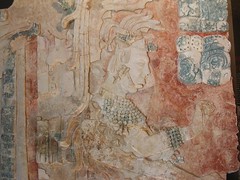
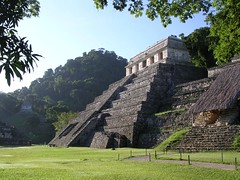
We loved the archaeological site of Palenque: the beautifulness and greatness of its temples reveal the history of a rich Mayan city and of legendary figures (above all, Pakal), however leaving them in the mystery. The jungle covers the ruins, creating a wonderful set. Unavoidably it’s the forest itself which becomes the main actor, with its colours and sounds. Numberless insects and birds, toucans and howler monkeys begin their own concert, while the “Palacio de las inscripciones” tell us about a healthy past: our imagination runs between the jungle and the ruins… it’s impossible not to remain fascinated.

  • Share/Bookmark

Travel towards Chiapas

Monday 25 September 2006 @ 02:02

Caribbean hut sleeping on our Mayan hammocks Mahahual Quintana Roo Yucatan Mexico cabañas

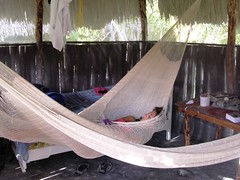
After almost three weeks of Caribbean, sun and paradisiac beaches, we ended our staying in the Yucatan peninsula moving from Tulum to Mahahual. This small village of fishermen, in the heart of the wonderful Costa Maya, let us feel the genuine rhythms of Mexican Caribbean. We slept in a cabaña, on our legendary Mayan hammocks (made of magüey)… here we found a very particular ecosystem, just within 100 meters: tropical jungle, mangroves, coconut palms and coral reef.

Finally, we started again our travel towards Chiapas. After a short staying in Chetumal, Quintana Roo’s capital, we passed near the “Reserva de la Biosfera de Calakmul”, along the border between Mexico, Belize and Guatemala, crossing numberless villages of campesinos and the deep jungle. Suddenly the great Yucatan plain ended and we entered a green region of hills, announcing the Sierra Madre and the city of Palenque. Finally we arrived in Chiapas, another dream of our life…

  • Share/Bookmark

Mayan world

Monday 18 September 2006 @ 19:43

Maya portrait woman and her child traditional dress Yucatan Quintana Roo Mexico

In the Yucatecan peninsula, every aspect of community life is influenced by Mayan culture. Although the strong presence of tourism, or maybe thanks to it, this feature suddenly appears very evident… and it will be more and more evident, travelling towards Chiapas and Guatemala. The ancient history of Mayas reflects itself not only on the impressive ruins, craftsmanship, flavorful cuisine, traditional clothes and dances, but also on the smiles and looks of the people we meet around, at the same time curious and ashamed. A history full of pride and love for freedom. The truth is that after 500 years of submission, Mayan people faces the chance to recover its dignity and consciousness of being carrier of an incredibly refined culture. Its power is demonstrated by the fact that a major part of population (inclusive young people) still speaks the native language. It is the best condition to guarantee the socio-cultural continuity of Mayan people, even though discriminations and conformation attempts are still going on.

Sometimes we feel Mexico is proud of its extraordinary cultural variety just to strengthen its touristic attraction, but it is not ready to completely accept the ethics of equality.

  • Share/Bookmark

Tulum, Caribe!

Thursday 14 September 2006 @ 00:56

Tulum Yucatan Mexico Caribbean beaches coral reef

After visiting the incredible archaeological site of Chichen Itza (where we saw the well-conserved pyramid of Kukulkan, which represents the Mayan calendar, and the “Gran juego de pelota”), finally we reached the Caribbean coast, by the village of Tulum. Far from being wild, this place showed us its best part with its paradisiac beaches: white sand, coconut trees and turquoise sea. Just what we were dreaming from a long time! Here we met a lot of people, above all local fishers and long-time travelers, and we shared with them lovely days and funny nights.

The most exciting experience has been to snorkel just over the coral reef: we had never seen so many colors and marine life, so many tropical fishes…

  • Share/Bookmark

Yucatan: from the highlands to caribe

Saturday 9 September 2006 @ 17:06

Arranged so quickly the consular issue, we restarted our nomadic travel: from Mexico City to Yucatan peninsula… after seeing the legendary volcano Popocatepetl (5500m of altitude), we went down from the highlands to the tropical jungle and we passed through the maritime cities of Villahermosa, Ciudad del Carmen and Campeche. The following morning we were already touching the hot waters of gulf of Mexico: a red sun, endless white-sandy beaches and a green forest, remembering us that we finally reached the land of Mayas… for the moment we are having a break in the Yucatecan city of Merida, but the Caribbean is too close now!

  • Share/Bookmark

Mexico city and resistencia civil

Wednesday 6 September 2006 @ 16:48

Mexican Child during street manifestation Mexico City 2006

We were fearing the contact with one of the biggest cities in the world, but we found an even welcoming metropolis. We will keep an unforgettable memory of a dramatically chaotic traffic… luckily we can enjoy kilometers of roads free of cars, thanks to the “bloqueos” organized by Lopez Obrador’s supporters. Basically they call for the recount of votes expressed by the people on July, 2. The pacific nature of this demonstration is particularly pleasant: thousands of people coming from any Mexican region are occupying the main streets of the city center (Zocalo and Avenida Paseo de la Reforma), trying to change the public opinion. To be honest, this target seems to be unreachable, but it’s a pleasure to see so many people, who believe in their ideas and endlessly organize concerts, film and documentary viewings, and any sort of artistic activity (murales, satire…).

Mexico city is a megalopolis extremely vivacious and dynamic, where all the tremendous contrasts of Latin America are clearly visible… society is based on hierarchies that mirror the skin colour: the most luxuriant quarters are surrounded by suburbs of huts, where water and electricity are still something for lucky people. But there’s no resignation, on the contrary a great willing to emerge through arts and creativity, that seem to find endless energies here.

  • Share/Bookmark

Teotihuacan

Friday 1 September 2006 @ 02:33

Pyramid of the moon from the sky Teotihuacan Mexico

The visit to one of the most impressive Mexican archaeological sites, it’s a very exciting moment for us. We admired the great pyramids (called Del Sol y De la Luna), which were built about 3000 years ago: their geometric perfection and symbolic nature, show the human desire to continuously exceed his own limits.

  • Share/Bookmark