Archive for the 'travel' Tag

Tinghir and Dades Valley

Tuesday 8 December 2009 @ 00:27

Tinghr and Dades Valley

There are moments in a journey in which consciousness is suspended, giving way to the cool morning breeze. In front of the bus station of Ouarzazate stands a fine powder, indicating the way to the Sahara Desert. Silently, we hear the cries of taxi drivers, waiting that they pronounce the name of our next destination, according to a ritual that is repeated from years. Other people appear from nowhere and they seem to be interested in moving to Tinghir along the Dades Valley.
Our Mercedes, a copy of the last century beautifully decked out in tinsel and purple advertising stickers, does not betray his nine hundred thousand kilometers traveled in extreme climatic conditions and, cleverly manipulated by the driver, proceed to tear down the strip of asphalt that is immersed in the arid landscapes of the Dades Valley. Temperature forces us to frequent stops, in the attempt to draw water from numerous wells and deep groundwater. Sudden green corners above tiny shops, where they sell rose water.
Finally, it unfolds by our eyes the glittering green strip of Tinghir palm garden, we are greeted by the smiling face of Youssef, who offers us a Berber tea.

Travel tip: overnight in the charming hotel Tombouctu (near the bus station), built on the ruins of a kasbah.

  • Share/Bookmark

Ouarzazate and Casbah of Telouet

Tuesday 13 October 2009 @ 19:08

Tizin Tichka, Atlas

The starry night, pursued by a multitude of souls who find peace only at the edge of the dusty roads, finally gave way to a warm and quivering dawn. We follow the foothills of the Atlas back in the direction of Marrakech, but just before the Tizi’n Tichka pass we turn right along a small trace of dust, which is the ancient salt trail, where caravans used to pass through along the way to Marrakech, or towards the mystery of Timbuktu.
The smiling and tired faces of the peasants, followed by the playful screams of children, tell us of a world flowing with the ancient rhythms of the seasons, with no worries but always in balance between simplicity and deprivation. The place is beautiful, the colors are warm and lively as an impressionist painting. We’re fascinated. At the end of our journey, we get finally to Telouet, village of Glaoui and home to a salt mine. We visit the Casbah, which immediately we rename “the storks”, accompanied by the friendly guide Mohammed, then we rest at the nearby restaurant, where we can enjoy the intense flavors of the Berber cuisine and enjoy a bucolic landscape.

Suddenly the phone rings. We are doing lunch with Lahcen, with green tea and pistachios, he is telling us of his aspiration to travel the world and meet people far away, we think of the curiosity of Moroccan people and how this unites us, making our discussions more and more exciting and passionate.
On the other side of the receiver an anxious Brahim, who meanwhile headed towards Zagora, a few hours by bus to Ouarzazate, to meet his family. His distant voice: “Salam friend, we have a problem … you and the girl should leave the house immediately, because my cousin arrives and if he sees her, he will make a big casino.” A moment of silence, then I think of the privilege and the emotions that we felt during the two days spent together: this is the best gift that they could make us; we thank everyone, we gather our few things and we are ready to go.
Morocco of a thousand contrasts and contradictions, it is 10pm and we have to find a hotel for the night. One more night in Ouarzazate.

Travel tip: relax yourself on the terrace of restaurant Lion d’Or in Telouet, enjoying the delicious Berber cuisine (tagine, cous cous).

  • Share/Bookmark

Tizi’n Tichka towards Ourzazate

Thursday 17 September 2009 @ 07:04

Casbah Taourirt, Ouarzazate

We walk towards the gare routiere, and invariably we are involved in the confusion pre-departure. As soon as we cross the threshold of the station, a swarm of young men in leather jackets, beggars, barefoot children and alleged long-time travelers gets around us. The cries are more and more lively and playful, then become nervous indicating a certain dissatisfaction with the deal which does not go on smoothly. In a few seconds, upon pronouncing the magic word (Ouarzazate), we find ourselves gently pushed towards a rickety bus, decked out in a multitude of gold and red colored ribbons and spangles. We finally felt at home. Now starts the bargaining for the price and the best seats. 30, 25, 20, the price goes down and down the claims: back seats of the bus and seats upholstered in dusty hair sheep.

We walk towards the bus station, and we are inevitably involved in the pre-departure hustle… finally the bus leaves, towards the desert, but we must now face the Atlas: dense pine forests, extensive golden wheat crops and quiet Berber villages, a brief stop in Taddert for lunch. We overcome the Tizi’n Tichka (2500 meters of altitude), which in Tamazight language means “pass of the pastures”. The hot and dry air announces the desert, the Sahara. In the journey, we meet Brahim, a sympathetic Moroccan who works in Bergamo; with him we make the first steps in the more authentic Morocco. He invites us to his cousin’s house when we arrive at Ouarzazate, we talk and he gives us something to eat, we understand that there is much to share and the possibility of establishing a truly warm relationship. We spend a pleasant day with Brahim and the three brothers (Lahcen is the only one who understands English), it is a pity not to speak French, but we can understand each other with Spanish and we try to learn the first words in Arabic (Shukran, naan/la, inshallah, salam/salem). They continue to offer their hospitality, in form of mint tea, pleasant chats and delicious snacks. We understand that mutual curiosity is not always enough to brake the cultural “wall” that separates us: we cannot merge our relativism with their way of thinking linked to Muslim culture. Even from children, lives of men and women are separated. For men it is given the privilege of choice, while for women the fate will always be indelibly marked by the teachings of the mother and the wish of the father and then of the husband.
During the night, upon having enjoyed a delicious tajine of lamb cooked with our new friends, we make a long trek up to the casbah of Taourirt, all together. The full moon creates a dream, it seems to animate the casbah and relive the times of its glory, when it was one of the residences of Glaoui, the pacha of Marrakech. Ourzazate, which is located where the Valleys of Draa and Dades meet, introduces to the first seeings of the Sahara Desert. The city is quite modern (it was founded by the French in the 20s), and it is still a place of transit along the routes of traders and tourists that, from Marrakech, lead to the desert borders of Zagora and Merzouga. The climate is tempered by its altitude which exceeds 1.100 meters.

Travel tip: sit down in a bar of the city center to enjoy a tasteful mint tea, skillfully served from the teapot, in order to release all its flavour.

  • Share/Bookmark

Nomadic travel’s Slideshow

Thursday 26 April 2007 @ 14:04

Nomadic travel mosaic: from USA to Peru, Mexico Guatemala Colombia Ecuador

A year ago began the adventure of this blog… a mosaic of emotions in the deepest heart of the American continent. We have interiorized a magical world, sometimes so complex to be hardly understood. From United States, thinking head of the world as it is nowadays, we have learned to leave aside preconceptions and replace them with curiosity. Mexico has donated to us the immense joy of the travel, endless horizons and the beauty of nature, but also the inexhaustible resistance of a people seduced and then abandoned. Guatemala, wonderful and moving, fertile land of the Mayan world, the search for a better future, that we joined through our cooperation as volunteers. Colombia, an oceanic and magnificent country, so wild to escape everyone’s look; the surprise of an electrifying ferment of lives. Ecuador, synthesis of the whole latinoamerican style, a luxuriant nature and pleasant people: the encounter with the Amazonian rain forest and its peoples, the eternal fight against the exploitation with no rules of the natural resources. Peru with its archaeological beauties, in the undiscovered northern Andean region; the emotion of the “suiza peruana” (Peruvian Switzerland), Huaraz and the Cordillera Blanca. Now we fall asleep on the last day, an ethnic mosaic of faces and looks smiles to us, the importance that they have had and they will have in our life, the promise to meet us another time, one day…
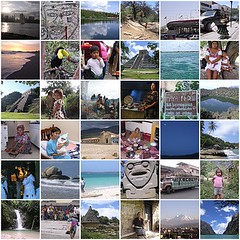
We added a terrific interactive tool from flickr, enabling to show all our photos in a slideshow. Just follow this link (Nomadic travel’s Slideshow page) and remember to leave some feedback, whether you think this is a good idea! Shortly we will return with new and adventurous travel stories about Latin America and especially South America…

  • Share/Bookmark

Nomadic Travel’s Mosaic

Sunday 15 April 2007 @ 14:09

Nomadic travel mosaic: from USA to Peru, Mexico Guatemala Colombia Ecuador

  • Share/Bookmark

Lima and Manual del Pendejo

Monday 9 April 2007 @ 14:44

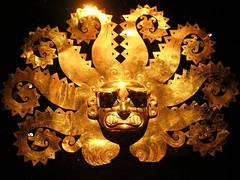
Moche, gold mask Pre-Columbian archeology Lima Peru

The last American week, once more and so short to seem already ended: the travel through Peru, fantastic but perhaps lived less intensely regarding the adventures in the other Latin American countries. Coming from the uncovered coast of the Pacific Ocean, Lima appears as an enormous and dusty strip of desert, at first sight quite unattractive. The traffic congests this big city reducing the historical center (around Plaza de Armas) to a funnel of smog, nothing romantic. People shout in order to sell goods of any type, from food to the most unthinkable objects. An old man shows us his product, saying “asì me gano la vida“, the Manual del Pendejo, that is expired daydreams and holy water… life in Latin America is never banal neither sweet, just demands a lot, maybe too much creativity.
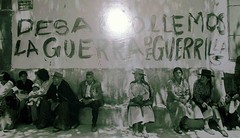
Peruvian civil war, Sendero Luminoso Fujimori Ayacucho massacres Andes

The Yuyanapaq.Para recordar museum (in memory of the two decades civil war, 1980-2000), remembers through an intense audiovisual exposition, that tragic period in Peruvian history and the sad genocide of the Andean people, a season of ideological contrasts that kicked up a big wave of terror in the country. As always, those who paid the worst price in this war were the indigenous people, particularly in the region of Ayacucho. Overwhelmed by a spiral of violence and terroristic actions, the country lost the conscience and suspended its own history.
  • Share/Bookmark

Trekking in the Cordillera Blanca

Monday 2 April 2007 @ 15:41

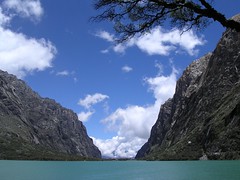
Trekking in the Cordillera Blanca Llanganuco Lagoons

The Semana Santa (Easter) is coming up and Huaraz begins to animate for the beginning of the season of trekking and mountaineering in the Cordillera Blanca. This splendid mountainous chain, that extends along 180 kilometers in the National Park Huascarán, includes the highest peak of Peru (Huascarán, 6768 meters) and one of the most beautiful mountains in the world (Alpamayo, famous for its north-western pyramid shaped face). Beside the most popular circuits, Santa Cruz trek (5 days between lagoons, snowy sloops and passes up to 5000 meters of altitude) and Lagunas de Llanganuco (see photos), exist numerous footpaths for trekking of varied difficulty, among which: Laguna Churup trek, Quilcayhuanca trek and Ishinca trek. All offer wonderful sights of the snowcapped peaks of the Cordillera Blanca. There are also numerous options of ascension to the summits of the mountains, without forgetting the neighbor Cordillera Huayhuash (Huayhuash trek). For further information on trekking and mountaineering in the region of Huaraz, a good starting point can be the Asociacion de Guias de Montaña de Peru. For the best sights of the Cordillera Blanca, cover the numerous paths of the Cordillera Negra, by foot, mountain bike or horseback.
  • Share/Bookmark

A dawn in Huaraz

Friday 30 March 2007 @ 01:42

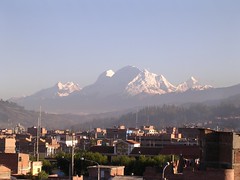
Cordillera Blanca from Huaraz scenic view picture Huascaran Alpamayo Peru

A dawn in Huaraz is worth the show of 30 snowcapped peaks coloring themselves of the flush transported by the icy wind. A dawn in Huaraz is worth the smile of a trembling old woman, crying aloud “¡Tamales!”. A dawn in Huaraz astonishes up to make you scream that you have conquered the roof of the world, or just the destination along the travel. A dawn in Huaraz takes your breath away, leading you where the lonely Andean condor can get. A dawn in Huaraz is worth 10 months of nomadic travel and many adventures, it’s the joy of time and the enthusiasm to discover every day new horizons. Now the day with its colors, the rural market and the women laughing, the shy smiles of the children, a horseback-ride or a long trek towards the lagoons of emerald (Llanganuco and Churup)… and many small stories to remember.
  • Share/Bookmark

Cañon del Pato, towards Huaraz

Wednesday 28 March 2007 @ 01:13

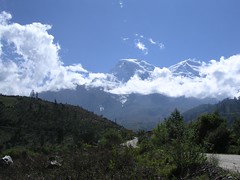
Huascarán snowcapped from Yungay Huaraz Peru Cañon del Pato

It’s dawn when the desert of the Peruvian coast, starkly desolated, is awakened by the first sun beams, that wearily play with the fog. In our mind Trujillo and the Moche ruins of Chan Chan, one interminable night at the bus terminal of “America Express”. The dream vanishes accompanied by the smell of iron and fish of the port of Chimbote, a place of frontier and maybe pretty picturesque. We choose the most spectacular way to return towards the Andes, travelling along the Cañon del Pato. The bus limps hardly along the dirty road, numerous staggering bridges slows down the way. The abyss under us grows constantly, the river in flood roars on the bottom of the valley. A system of narrow galleries forces us to long waits when we intercross other means of transporting but, after hours of traveling, finally the horizon opens on the Cordillera Blanca, one of the most spectacular places of the world, with its numerous snowcapped mountains (Huascarán, Alpamayo, Huandoy, all beyond the 6000 meters). Along the Callejon de Huaylas from Caraz, Yungay and Huaraz, we enjoy a landscape that takes our breath away…
  • Share/Bookmark

Travel from Chachapoyas to Cajamarca

Saturday 24 March 2007 @ 04:17

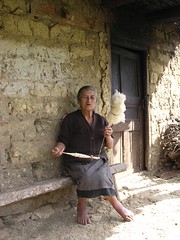
Elderly woman Chachapoya, indigenous cultures alive Cajamarca Altiplano Andes Peru

We wake up early in the morning, our first unforgettable week in Peru ends with an incredible travel: towards the past, the sky, a hard but authentic present. The road that connects Chachapoyas to Cajamarca is a pebbly and dusty way, that vanishes inexorably swallowed by abandonment and nature. We join the procession of hundreds of campesinos who, in the day of the market, head towards the pueblo of Yerbabuena (Rio Utcubamba); trading on every available means of transporting (camiones, horses, bulls) or by foot. It rains and the damp confuses colors and flavors of the market, shouts and mud sketches. In this atmosphere the millenarian exchange between the products of the Altiplano and those of the forest happens. We continue towards the archaeological site of Revash, an interesting example of Chachapoya architecture. The road follows a splendid green valley until Leymebamba, where we visit the museum “Centro Mallqui”, approximately 200 Chachapoya mummies are guarded together with numerous finds discovered near the Laguna de los Condores. Now we go up firmly, the vegetation disappears and we reach an altitude of 4000 meters. We catch up the clouds and we enjoy an impressive horizon, during the sunset.

Quickly we return down, until we touch the waters of Rio Marañon, near the village called La Balsa (500 m.s.l). While we have dinner, the waitress tells us that various armed robberies recently took place along the road for Cendelin: a wearing discussion with our driver rises, but the decision is to continue. In the fog we reach the objective of the day (Cendelin), it’s late in the night. We all (Michael and Lukas, our travel companions, too) are exhausted. The following day we complete the distance from Cendelin to Cajamarca, hours and hours of up and down by bus again. A one-shot adventure, a travel in the most authentic Peru.
  • Share/Bookmark

Catarata de Gocta

Tuesday 20 March 2007 @ 17:52

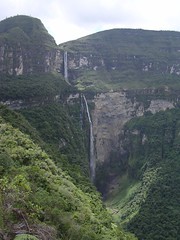
Catarata de Gocta, highest waterfall of the world Peru South America

This is the third highest waterfall in the world, second only to the Salto Angel in Venezuela (972 metres) and the Tugela Falls (South Africa, 948 meters). Considering the two falls it’s 779 meters high, really spectacular… We got there along a hard trekking through what remains (unfortunately not so much) of the Peruvian mountainous rain forest.
  • Share/Bookmark

Kuelap and Chachapoyas

Monday 19 March 2007 @ 15:57

Kuelap's ruins, fortified citadel Chachapoya Pre-Columbian civilization Peru South America

The Chachapoya was one of the most mysterious and independent Pre-Incaic cultures. They lived in the isolated and hard valleys around Chachapoyas, capital of the Amazonas department. Iquitos seems so far from these places, but the immense rivers indicate us the direction towards the Amazon. The Chachapoya had been able to adapt to a hostile environment, building fortified cities (Kuelap) and necropolis of sarcophagi on the impressive slopes of the mountains (Karajia). The numerous mummies that during the last few years have been discovered, following the crescent interest for this civilization, tell us a history of warriors (“Guerreros de las Nubes”), skillful farmers and architects. Kuelap, the fortified citadel of the Chachapoya, is an example of their ability, second only to Machu Picchu for majesty, still nearly undiscovered. Kuelap was erected in about 700 d.C, on a steep slope at 3000 meters of altitude and still shows in all their greatness the defensive walls, hundreds of meters long and till 20 meters high. Manuél guide us in the Chachapoya world and their houses with circular plant and tapered thatch roof. Complex ceremonial rituals, planning the sacrifice of animals (llamas), venerated the figure of the god Sun.

  • Share/Bookmark

From the border to Chachapoyas

Sunday 18 March 2007 @ 02:16

Orchid tropical flower Amazon Peru Kuelap Chachapoyas

The Andean region of the Northern Peru is a dusty but really interesting place: being a route virtually ignored by the tourism, we find some difficulties with transportation. Everything is widely repaid by the wild beauty of the places we visit. From San Ignacio we cover a tremendous dirty road by colectivo, until Jaén. A lively commercial center, city of passage between the coast and the Amazonian river basin of Peru, even though nearly lacking in reliable ways of communication. The successive day, not without difficulties, we continue the travel towards the desert village of Bagua and therefore San Pedro Ruiz, following a tenuous dusty trace, on the bottom of canyons digged by Rio Marañon and its affluents. In the night we reach Chachapoyas.

  • Share/Bookmark

Ecuador-Perú, via Zumba

Friday 16 March 2007 @ 02:52

Trucks and Andean dirty roads Peru Ecuador adventure nomadic travel South America

When our German friends wake us up, soon in the morning, we begin the travel from Vilcabamba towards the frontier between Ecuador and Peru. Our route, passing through the village of Zumba, follows an off the beaten track. After a pass that dominates the valley of Vilcabamba, we begin a long descent through the mountain jungle of the Podocarpus National Park. The bus makes frequent stops, often in ghost villages, but there are always people who wait for our arrival; shortly we are swept up by a mass of people, goods and animals. After approximately 6 hours of travel we reach Zumba, the first half of our itinerary. Nearly 2 hours of camioneta separate us from the Peruvian border, but a bridge swept in a blaze by the river forces us to wade: the adventure gets more and more interesting! It’s already evening when we get our passports stamped, by the international bridge of La Balsa. 2 more hours of colectivo (dispelling any doubts of other travelers: 12 soles, negotiable till 10) and we arrive in San Ignacio, tired but happy… We leave Ecuador, a very small Latin American country that has given us many unforgettable experiences and the hope that there can be a future, when people have the courage to fight for their own rights. Now Peru, a giant for beauty and history, the crib of the Inca civilization.

  • Share/Bookmark

Vilcabamba, the eternal youth

Wednesday 14 March 2007 @ 15:12

Juggling nomadic travel friends Vilcabamba Ecuador

After a short staying in Cuenca, third city of Ecuador and famous for its university, we go on with our travel that is everytime more nomadic and itinerant. Now our goal is Vilcabamba, a very small pueblo next to the Southern border with Peru. The mystery which wraps this village from the eternally vernal climate, it’s the longevity of its inhabitants. Effectively we are astonished to meet so many old and brilliant men, but as the record of Vilcabamba is on everyone’s lips, probably many people declare more years of their actual age… Meanwhile we spend a nice Sunday with music and “malabarismo” (juggling) performances, by the group of artists Pacha Feria.

  • Share/Bookmark

Tungurahua, bloqueos and Ingapirca

Wednesday 14 March 2007 @ 14:52

Ingapirca archaeological site Inca trail Ecuador

Going through a dirty road from the Amazonian river basin, we return on the Andean Altiplano; and the emotions quickly involve us. We assist from far away to the explosive eruption of the Tungurahua, just a few weeks after our staying in Baños (at the slopes of the volcano). We participate to the bloqueo of the Panamericana in true Latin American style and for some hours we integrate with the people of a very small village and its problems. After a short staying in Riobamba, defined “Sultan de los Andes”, we head to Cañar. From there, an old bus takes us near the Inca ruins of Ingapirca. Beyond the historical interest, we discover a charming place, inhabited by simple and nice people, where finally we can caress some llamas, the famous Andean camelids, that rest near the archaeological site.

  • Share/Bookmark